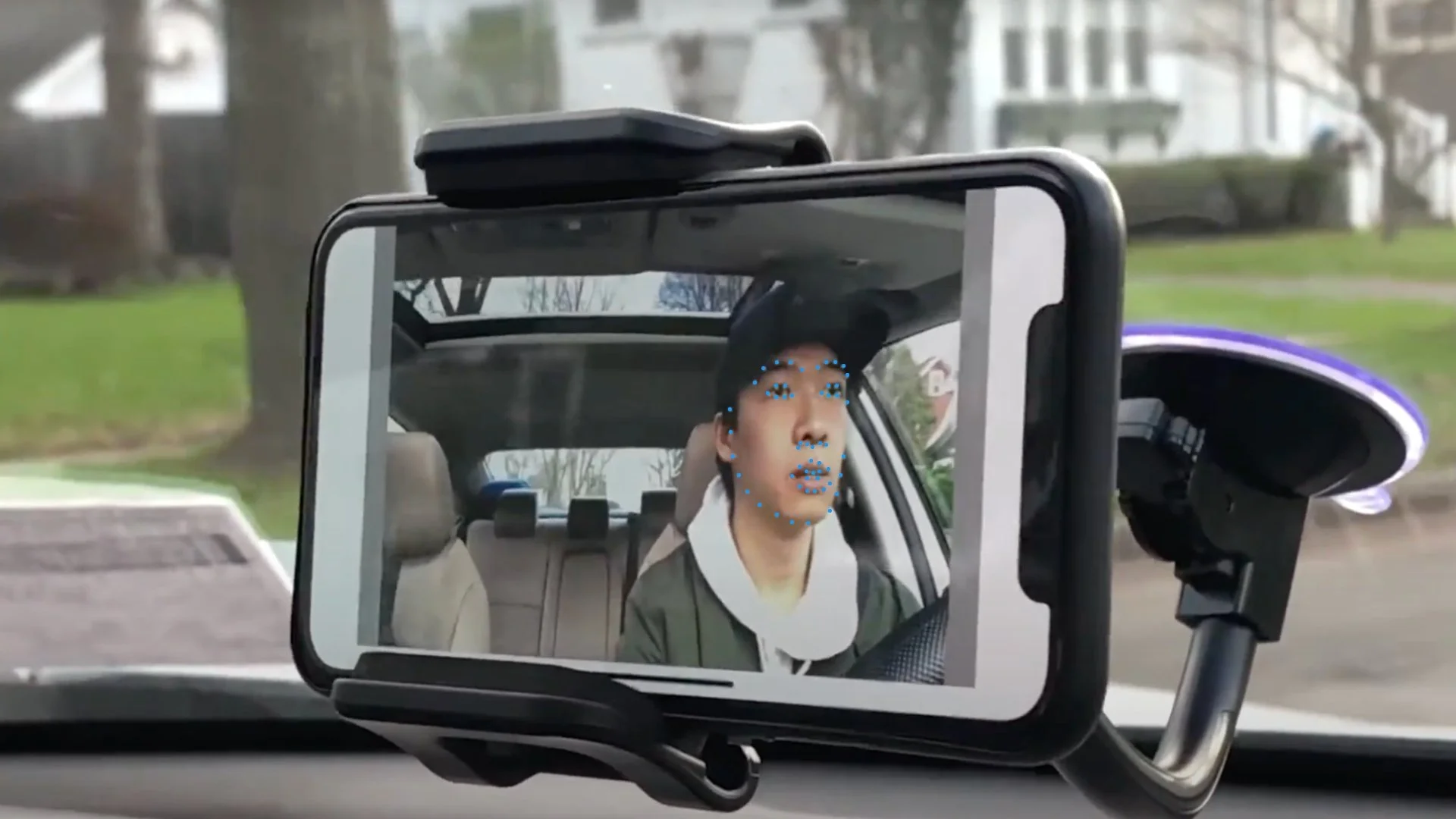
Target at microsleep: a brief state of drowsy unconsciousness that can happen even if your eyes remain open. Detect drowsiness at the earliest stage possible Alert and guide the driver to the nearest rest area.
Role: UX Designer and programmer / Team: 4 people team / When: April 2022
Project Proposal
-
As a driver who drove lots of long-distance trips, I’m always worried about myself driving while drowsy and the risks of causing accidents. The hard thing is, most of the time when I realized that I’m drowsy I already find myself leaning towards a bumper or guard bar, which is very close to crashing my car.
Our project is proposing an advanced solution for the high accident rate caused by driving while drowsy. The highlight of our system will be its high flexibility and multiple-dimensional evaluation system. Our system can be downloaded anytime and used through a smartphone with a camera, it can also be implemented onto the dashboard or even in-car camera if collaborating with the manufacturer. That is to say, our system is highly flexible and vehicle independent, drivers can use it anyway they want with minimum cost, which increases user acceptance. The other highlight is our multidimensional evaluation method, which takes into account more than just eye-lids movement. We believe that there are more aspect that needs to be considered when we are indicating if a person is drowsy or not. For example, yarning will be a solid sign for drowsiness, and it is not addressed by previous drowsiness detection codes.
-
According to the interview, it is fair to conclude that most of the drivers have experienced dizziness or tiredness during driving. It is a common situation no matter how long you have been driving. What’s more, the drivers most of the time can not recognize the early stage of tiredness, and when they realize the symptom of dizziness, it is usually too late to find a rest station in a short amount of time. The current system to detect dizziness is not effective enough, and most of the time it can not help. There is huge potential for a system that can recognize the early stages of dizziness, remind the driver, and plan the route to the nearest rest station.
-
To implement the functionality of our project, we need to first identify some criteria to tell whether the driver in a specific frame is drowsy or not. The first sign we thought about was our heavy eyelids. According to a study of The Accuracy of Eyelid Movement Parameter for Drowsiness Detection (Wilkinson, 2013), ocular measures of the duration of eye closure are promising real-time indicators of drowsiness. The second matrix we use is the frequency of yawning. Boredom and drowsiness are the main stimuli for yawning when a person’s surrounding environment is no longer able to sustain their attention (Gupta, 2013). The next criteria are the forward-leaning head posture. This sign of drowsiness is caused by weakened support of the head, which leads to detached attention from the wheel and car surroundings (Teyeb, 2014). With these criteria, we will be able to assess a quantified level of drowsiness of a driver based on the appearance and duration of behaviors above.
We use the OpenCV library for facial and posture detection. OpenCV provides a great tool for identifying facial features out of moving frames of pictures, or videos. It puts coordinates on facial landmarks based on the training result of the iBUG 300-W dataset. A diagram on the left below shows how the landmarks are spread.
We will be using the following 3 facial features from landmarks in the above-left diagram:
The openness of both eyes (distance between upper and lower eye boundaries)
The openness and duration of openness of mouth - yawning (distance between upper and lower mouth boundaries)
The head rotational posture (using landmarks to obtain the 3D orientation of the head with respect to the camera)
-
https://drive.google.com/file/d/1au1xlikDRk7Po5UJRKKln7n7C4NpG5PM/view?usp=sharing